
Next’s public information gives UK shoppers a practical starting point for a clothing decision: a women’s measurement guide, length categories for jeans and trousers, footwear sizing references, and visible help and returns routes. This review explains how to use those checks before ordering, while keeping separate the questions the published pages do not answer about item-level fit, comfort, quality, durability, or everyday value.
Scope and Evidence: What This Next Review Can Assess
If you’re deciding whether to browse or buy from Next, the first useful question is what can be checked before checkout. This review uses two official Next pages. The Women’s Sizing Guides page explains how to measure the body and presents separate tables for tops and dresses, jeans and trousers, and footwear and accessories. The Next Help page visibly brings together help, chat, delivery information, an Arrange A Return route, customer services, contact and store-locator options.
Those pages support a documented buying guide, not a hands-on product verdict. They can show which body measurements and garment-length categories Next publishes, and where a shopper can start looking for help. They do not, on their own, establish how every garment fits, how fabric feels, how construction performs over time, or whether a specific item represents good value. Keeping that boundary clear matters: a size table is a pre-purchase check, not a substitute for item-specific information or independent experience.
For a shopper, the practical outcome is a two-part decision. First, use the official measurements and length categories to reduce avoidable uncertainty. Then verify the exact item information and the current buying and returns conditions that matter to the order. If a question remains unresolved, treat it as an open question rather than turning a general chart into a guarantee. A separate women’s clothing measurement guide can help with bust, waist and hip technique, while a general online-shopping returns checklist can help when comparing retailer terms.
Women’s Sizing Guide: The Most Useful Published Checks
A useful feature of Next’s women’s guide is that it starts with measuring the body. It tells shoppers to use the information icons for guidance on measuring each area and then select a sizing guide from the drop-down. That sequence encourages a shopper to work from current measurements rather than relying only on an old label or a remembered size.
For tops and dresses, the published table covers UK sizes 4 through 26. It gives bust, waist and hip measurements in both centimetres and inches. The table is therefore useful for making a first comparison: record your three measurements in one unit, choose the relevant UK size range, and note any gap between the chart and your own measurements. The guide does not require you to convert units yourself, which helps reduce a simple source of ordering error.
Jeans and trousers are handled separately, with five named length choices: Petite, Regular, Long, Extra Long and Tall. The listed height bands run from Petite at 150–160 cm (4'11”–5'3”) to Regular at 160–167.5 cm, Long at 167.5–177.5 cm, and Extra Long and Tall at 177.5 cm and above. The associated published lengths are shown in both systems: 69, 74, 79, 84 and 89 cm, alongside 27.5, 29, 31, 33 and 35 inches. A shopper can therefore consider height and the intended length category before adding a pair to the basket.
The footwear and accessories area adds another reference point. The published table includes UK, EU, US and AU/NZ size columns, foot length, and standard, wide and extra-wide width columns for footwear or slippers. That is useful if a shopper needs to compare sizing systems or check whether a width category is available. It should still be read as published sizing information, not as proof that a particular shoe will feel comfortable.
A sensible routine is to save your measurements, keep centimetres or inches consistent, and read the exact category that matches the item. Use the tops-and-dresses table for those garments, the jeans-and-trousers table when length matters, and the footwear table when comparing size or width references. These published distinctions can narrow the search before checkout without pretending that every product behaves identically.
What the Published Sizing Information Does Not Confirm
A general size chart can answer a narrow question: which body measurements and length categories does the retailer publish? It cannot answer every item-level fit question. A chart covering UK sizes 4 to 26 for tops and dresses does not establish that every cut, fabric, neckline, rise, leg shape or construction will fit consistently across those sizes.
The published guide also does not confirm consistent fabric stretch, garment-specific measurements, construction quality, durability, or independent testing. Those are separate questions. A shopper may find that two garments carrying the same nominal size feel different because their designs or materials differ, but the general chart alone cannot be used to prove or disprove that outcome. The careful conclusion is simply that the chart is not designed to settle it.
The same limit applies to footwear. Next publishes foot-length references and standard, wide and extra-wide width columns in the footwear or slippers table. Those labels help a shopper identify which measurements to compare, but they are not evidence of comfort, support, suitability for a particular foot, or performance during extended wear.
This distinction is especially important when a purchase is being judged on everyday value. A convenient measurement table can reduce the chance of choosing an obviously unsuitable size, but it does not establish how long an item will last, how it will feel after washing, or whether the price is justified by performance. Those conclusions require item-specific details and, where relevant, additional independent evidence.
Use the guide as a screening tool. If your measurements and the published category align, move to the next question: what does the exact product page say, and what remains unknown? If the answer is still unclear, do not treat the general table as a guarantee. Carry the uncertainty into the support and returns check instead.
Returns and Help: What the Public Buying Pathway Shows
Next’s public help and returns pathway shows several ways to continue the buying decision. The page includes a help search, Start a Chat or online live chat, Frequently Asked Questions, Delivery Information, Arrange A Return, Product Recall, Customer Services, Contact Us and a Store Locator. A customer-services telephone number, 0333 777 8000, is also displayed on the page, with a note to check with the service provider for charges.
That visible menu is useful because it tells a shopper where the retailer expects common questions to be handled. Someone checking delivery can start with Delivery Information; someone considering a return can use Arrange A Return; and someone who needs a direct answer can look for chat, customer service or contact options. Store-locator support may also matter when a shopper wants to identify a nearby store.
The important boundary is what the visible page does not establish. The route names do not by themselves confirm the return window, any fees, exclusions, refund timing, condition requirements, or eligibility for a particular order. They also do not tell you whether a specific item follows a different process. Those details may affect the practical value of a purchase, so they should be checked in the current terms relevant to the order before checkout.
A useful pre-purchase check is to open the relevant help or returns route, read the detailed conditions, and keep the order information needed to refer back to them. Do not assume that the presence of an Arrange A Return link means every return is cost-free, automatically accepted, or resolved within a particular timeframe. The link proves that a route is visible; it does not replace the terms. A separate returns-and-refunds checklist can help you record windows, fees, exclusions and refund timing before you rely on the process.
If a question is not answered online, the page gives several support starting points. Phrase the question around the exact item and order circumstances, and record the response if it affects the decision. This keeps the support pathway separate from the sizing chart: one helps you investigate conditions, while the other helps you compare published measurements.
A Practical Next Buying Checklist for UK Shoppers
AI-generated generic editorial illustration — not a retailer product photo and does not depict the reviewed product or service. Turn the documented sizing and support evidence into a simple UK shopper workflow that reduces avoidable uncertainty without implying confirmed product performance.
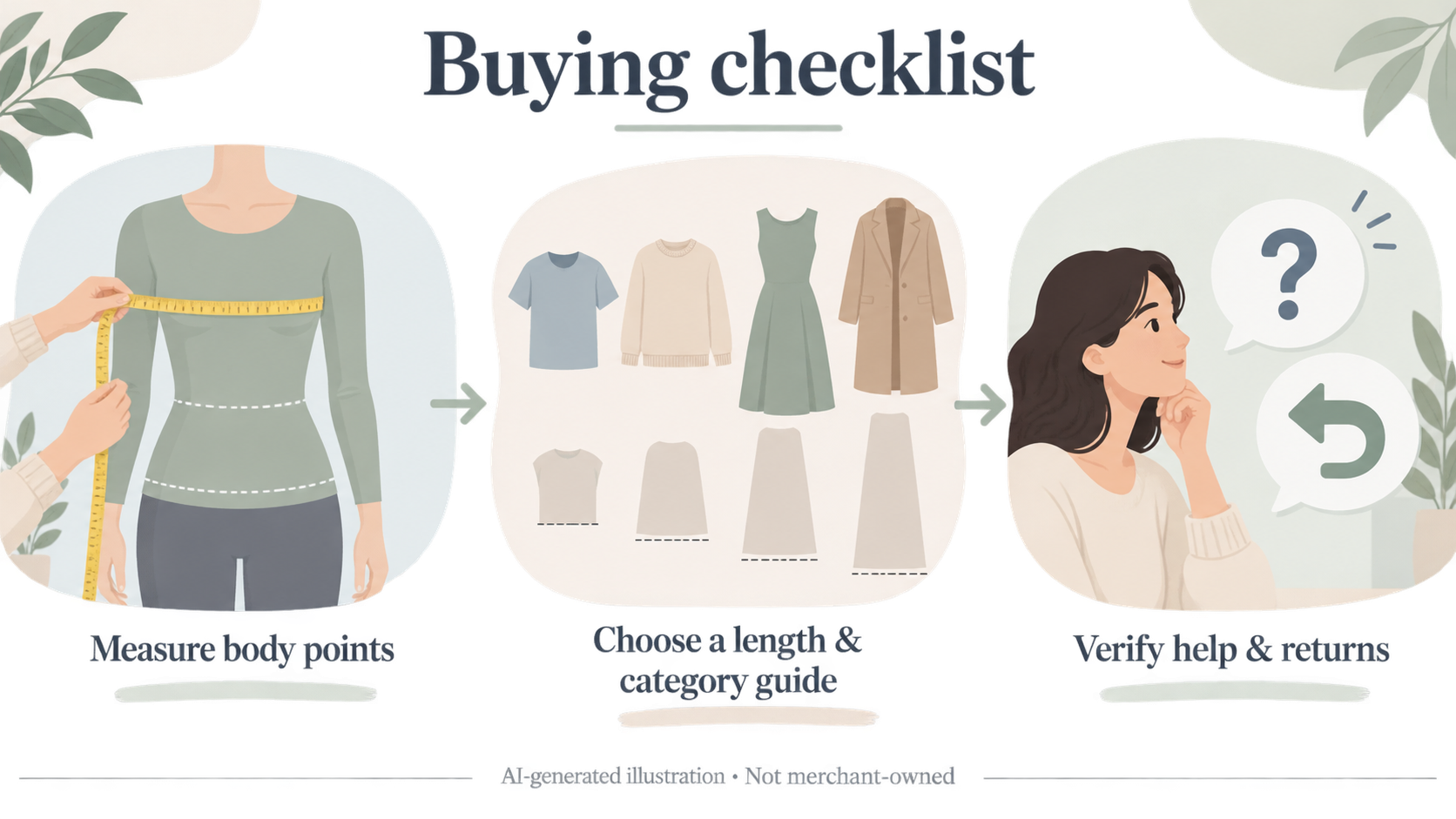 A measurement-first workflow can make the decision more deliberate without claiming that it predicts product performance.
Measure the relevant body points. For tops and dresses, take current bust, waist and hip measurements and record the unit you used. If you are choosing jeans or trousers, note height as well, because Next lists different length categories against height bands. For footwear, note the foot-length reference and the width category you need to compare.
Select the matching Next guide. Use Tops and Dresses for those garments, Jeans and Trousers when the length choice matters, and Footwear and Accessories for the published size-system and width references. Read the table in centimetres or inches, rather than switching between units mid-comparison. If the product sits in a named length category, check that category before treating the size choice as complete.
Separate the general chart from the exact item. Look for any product-specific measurements, fit notes, fabric or care information that Next actually publishes for the item. If those details are not available, mark them as unknown. Do not assume that a general women’s chart settles questions about a particular cut, stretch level, rise, leg shape, width feel or construction.
Check help and returns before checkout. Use the public Help page as the starting point for Frequently Asked Questions, Delivery Information, Arrange A Return, chat or customer services. Verify the current conditions that apply to your order, including any window, cost, exclusion, refund or eligibility detail that matters to you. If a return route is central to your decision, do not leave this check until after the order arrives.
Make an arrival-stage check. Before removing tags, using the item or discarding packaging, compare what arrived with the order details and inspect the item in the condition required by the relevant terms. Keep the order confirmation and any support correspondence. If the item does not answer the fit or condition question you were trying to resolve, having the documentation ready makes the next decision clearer.
The go-or-no-go result should be explicit. Proceed when the published measurements are usable for your decision, the relevant length or width category is understood, the remaining unknowns are acceptable to you, and the current help or returns conditions are clear. Pause when a key measurement, item-specific detail or return condition remains unresolved. This approach does not promise a perfect first order; it simply reduces avoidable uncertainty and makes the remaining uncertainty visible. A separate clothing-measurement guide can help when choosing between length categories, while a post-purchase checklist can keep inspection, documentation and returns preparation together.
Check Next’s sizing and returns information before ordering.
Who This Information Is Most Useful For
This information is most useful to UK shoppers who want a first-party starting point before buying: they can measure themselves, compare those measurements with the women’s tables, consider jeans and trousers length categories, and find visible help and returns routes. It is also useful for shoppers who prefer to make the decision in stages, recording what is known before they weigh what is not.
It is less complete for someone whose main priority is fabric feel, long-term durability, construction, comfort, or real-world fit across different garments. These pages do not answer those questions in enough detail to support a quality verdict. Those shoppers should seek additional independent evidence for the particular item or category rather than treating the chart as a substitute.
For everyday value, use a framework rather than a verdict. Ask: can I measure and choose the relevant published category; can I find the item-specific information I need; are the help and returns conditions acceptable; and which uncertainties am I willing to carry? That gives a more transparent go-or-no-go decision than claiming that a general chart proves quality or value.
Frequently Asked Questions
What measurements does Next publish for women’s tops and dresses?
Next publishes bust, waist and hip measurements for UK sizes 4 to 26. Each is provided in centimetres and inches. The guide tells shoppers to measure their body and select the relevant sizing guide. Those are body-reference measurements, so they help with an initial size comparison; they do not prove how a specific garment will fit.
Does Next provide jeans and trousers length guidance?
Yes. The guide separates Petite, Regular, Long, Extra Long and Tall. It pairs those categories with height ranges and published lengths in centimetres and inches. This gives shoppers a way to consider length before ordering, but it does not guarantee the finished fit of every style or fabric.
Where can shoppers find Next’s help and returns options?
The public help page shows a Help search, Start a Chat or online live chat, FAQs, Delivery Information, Arrange A Return, Customer Services, Contact Us and a Store Locator. It also displays a customer-services number. Shoppers should still open the relevant current information to check windows, fees, exclusions, refund timing and eligibility for their own order.
Can this information confirm that a particular Next item will fit well?
No. The general chart can help you compare published body measurements, length choices, foot length and width references, but the published information does not confirm item-level fit, fabric stretch, comfort, construction, durability or independent testing. Use it as the first check, then look for item-specific details and verify support or returns conditions before deciding.
Sources
Related reading
- Best UK high-street brands for wardrobe essentials: evidence-led top choices
- Marks & Spencer vs Uniqlo: which is better for everyday wardrobe basics?
- Marks & Spencer clothing review: strengths, limits and practical alternatives
- Uniqlo UK clothing review: who it suits and where the trade-offs sit
Editorial information: About our editorial team · Read our editorial policy · Read our affiliate disclosure.