
The short answer: Marks & Spencer or Uniqlo?
Neither Marks & Spencer nor Uniqlo can be declared universally better for everyday wardrobe basics from the available evidence. The useful answer depends on what you need to resolve first: finding a broad size-guide reference or matching measurements to a specific product.
Marks & Spencer’s official size-guide hub is organised by categories including women, lingerie, men, children, school-uniform sections and home, alongside general size guidance. That makes it a sensible starting point when you want a retailer-level reference point across several types of purchase.
Uniqlo’s official measurement FAQ describes a more explicit measurement-led route: use existing clothing as a reference or take your own body measurements, then compare them with the size chart on the individual product page. That may suit shoppers who prefer to work from dimensions before choosing between cuts or sizes.
For denim, the supplied Guardian example is a useful reminder to check construction, stretch, care and likely cost per wear. It is not a Marks & Spencer-versus-Uniqlo test: it discusses particular denim products, including a Uniqlo collaboration alongside Alaïa. My recommendation is therefore conditional: choose the retailer whose product-level information best answers your fit question, and treat wear or price stories as product-specific signals rather than a brand-wide verdict.
How this comparison is scoped
“Better everyday basics” is not one fixed test. For a UK shopper, it can mean fewer measurement surprises, an easier route from a familiar garment to a size, fabric and care details that match the intended use, acceptable wear over time, a price that makes sense for expected use, and buying terms worth checking before checkout.
This article treats those as separate questions. Size guidance can tell you how to begin; product-page fit details can tell you whether a particular cut is relevant; composition and care instructions help you anticipate maintenance; an independent wear report can illustrate what to look for; price is value context, not proof of quality; and current retailer terms still need a product-specific check.
The evidence is deliberately mixed. M&S contributes official information about the structure and categories of its size-guide hub. Uniqlo contributes official instructions covering body measurements, clothing measurements and product-page size charts. The Guardian contributes independent editorial reporting on particular denim items, including construction, shape retention and price context. These sources answer different questions, so they should not be blended into a single score.
The result is a decision guide for everyday basics, not a laboratory test, survey of customer returns or claim about every garment. “Better” here means better supported for your stated priority.
Fit information side by side
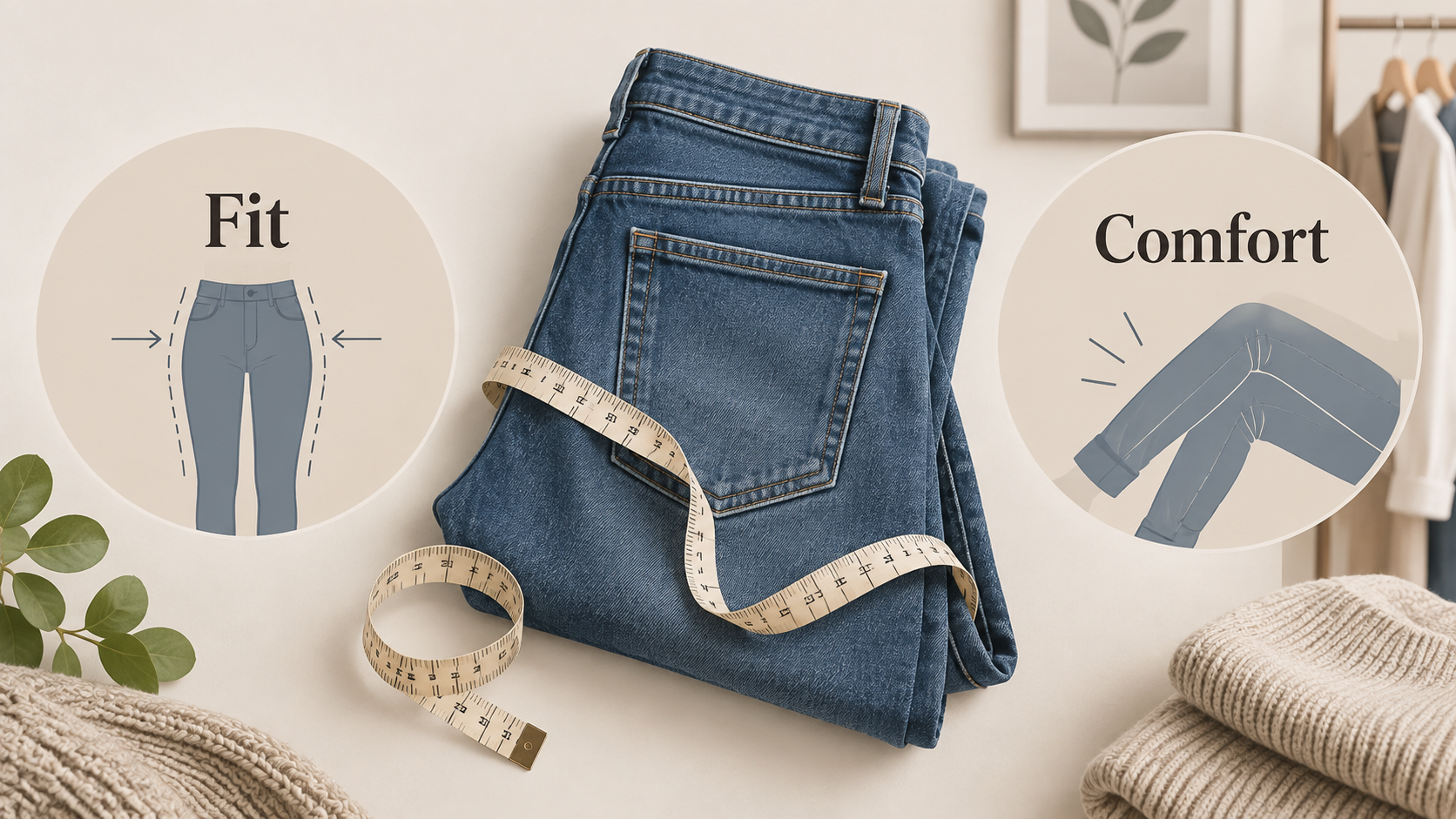
AI-generated generic editorial illustration — not a retailer product photo and does not depict the reviewed product or service. Show the shopper workflow for comparing existing clothing or body measurements with the relevant official size chart before choosing a size.
Fit information is the first practical filter because a size label on its own cannot tell you how a particular garment will feel or sit. The two official resources supplied for this comparison offer different routes into that decision.
M&S’s size-guide hub works as a central index. Its listed categories include women, lingerie, men, children, boys’ and girls’ school uniform, home and general size-guide sub-categories. For a shopper moving between different departments, that category-led structure can make it easier to find the relevant reference area before opening product pages.
Uniqlo’s customer-service guidance sets out a more explicit sequence. It recommends using the measurements of existing clothing as a reference or taking your own body measurements. It then directs the shopper to compare those measurements with the size chart available on each product page. The same guidance covers body-measurement routes for men, women, kids, babies, footwear and maternity, and clothing-measurement routes for tops, bottoms, bras, shoes and accessories.
In practical terms, M&S gives you a broad place to start, while Uniqlo explains the measurement exercise more directly. That does not make one guide a guarantee of better fit. A useful comparison still needs the exact garment’s chart, its cut, its fabric composition and the amount of ease you want. A straight-cut trouser, a relaxed sweatshirt and a stretch garment may require different judgements even when the nominal size is the same.
The safest workflow is simple: measure a well-fitting item or yourself, record the relevant dimensions, open the exact product page, and compare like with like. If a product page leaves an important measurement or construction detail unclear, treat that uncertainty as part of the purchase decision rather than filling the gap with assumptions about the retailer.
Potential strengths of Marks & Spencer
M&S’s documented strength in the supplied evidence is the structure of its central size-guide reference. The hub brings several departments into one navigation point, with listed areas for women, lingerie, men, children, school uniforms, home and general size guidance.
That breadth may be useful for a shopper who wants to make several everyday purchases across a household or across different clothing categories. It gives the buying process a recognisable starting point: locate the department, identify the relevant size-guide area, and then move to the individual item.
The benefit is practical organisation, not proof that every M&S garment will fit more consistently than a Uniqlo garment. The official page evidence does not establish superior comfort, fabric quality, durability, returns, alterations or care outcomes. Nor does a category list replace the details of the garment in front of you.
Use the M&S hub when its category structure answers the first question you have. Then check the product page for the cut, composition, measurements and current terms that determine whether that particular basic is suitable.
Potential strengths of Uniqlo
Uniqlo’s documented strength is the clarity of its measurement-led buying process. Its official FAQ tells shoppers to use an existing garment as a reference or take their own body measurements, then compare those measurements with the size chart on the relevant product page.
That is a useful sequence for people who already own a pair of trousers, shirt or knit that fits well and want to compare dimensions rather than rely on a familiar size label. It also gives a practical method for online buying: measure first, inspect the product chart second, and make the size choice only after the two are aligned.
The guidance is broad in scope. It includes body-measurement sections for men, women, kids, babies, footwear and maternity, and clothing-measurement sections for tops, bottoms, bras, shoes and accessories. That can make the process easier to adapt when the purchase is not a standard adult top or bottom.
The important qualification is that a well-described process is still a process, not a fit guarantee. The FAQ does not prove that all cuts, fabrics or categories will fit the same way, and it cannot replace reading the exact product page. If your measurements sit between sizes, or the intended shape is unclear, record what you are prioritising—room, length, waist fit or drape—and check whether the item’s details support that choice.
Limitations and evidence gaps
The available evidence is useful for choosing a starting method, but it does not answer every question a shopper may reasonably ask. In particular, it does not establish a universal winner for:
- fit consistency across all garments;
- durability or long-term shape retention across both retailers;
- fabric quality, comfort or construction across everyday basics;
- returns, exchanges, alterations or delivery conditions;
- care outcomes after repeated washing; or
- value across different prices, materials and rates of use.
The M&S evidence confirms a central size-guide structure and its listed category coverage. It does not provide a like-for-like assessment of a particular M&S garment against a particular Uniqlo garment. The Uniqlo evidence explains how to use existing clothing, body measurements and product-page size charts. It supports a more informed selection process, but it does not guarantee a consistent result for every cut or fabric.
The independent Guardian report must also be kept in its lane. Its example concerns specific denim products: an Alaïa pair priced at £800 and a JW Anderson collaboration with Uniqlo priced at £34.90. It reports particular observations about those products; it is not a controlled Marks & Spencer-versus-Uniqlo comparison of every basic. The absence of comparable M&S wear evidence in this set is not proof against M&S.
Before buying, verify the exact product page and the retailer’s current terms. Look for garment-specific measurements, cut, composition, stretch content, care instructions, stock or alteration information where relevant, and the conditions that apply to the purchase. If one of those details matters to you and is missing, the evidence-led answer is to pause or broaden the shortlist—not to assume the missing fact.
Fabric care, wear and value signals
AI-generated generic editorial illustration — not a retailer product photo and does not depict the reviewed product or service. Support a bounded discussion of denim construction, care, wear, and value signals without presenting the independent editorial example as a full Marks & Spencer versus Uniqlo product test.
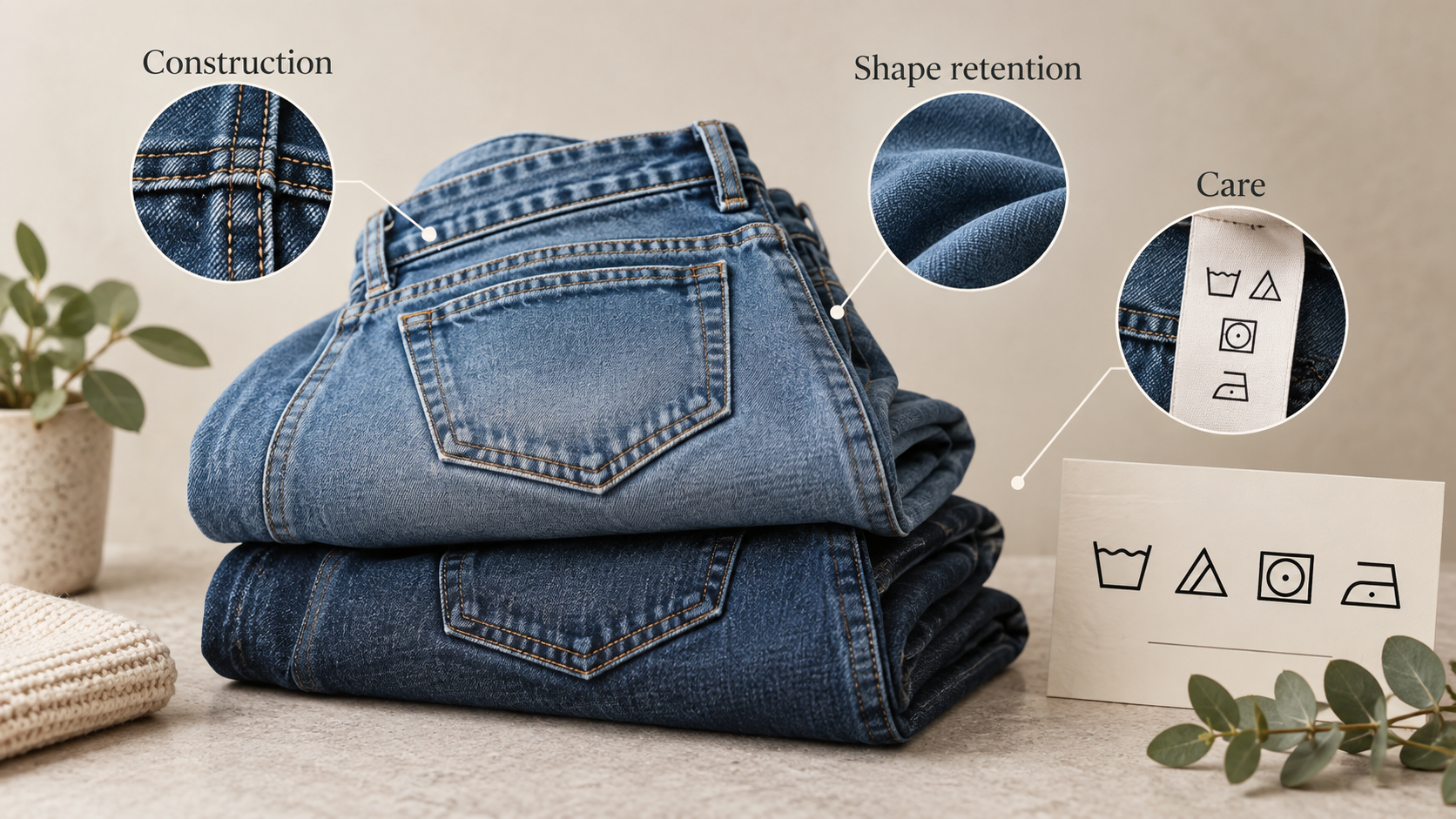 The Guardian’s denim report is most useful as a bounded example of why fabric, construction and care deserve separate attention from the brand name. It compares an Alaïa Aegean-blue pair at £800 with a £34.90 JW Anderson collaboration from Uniqlo. The report says both sat well initially—the Uniqlo pair slid on nicely first time—but that, after some wear, the latter had begun to lose shape in key areas.
That observation should not be converted into a verdict on all Uniqlo denim, much less on all Uniqlo basics. It is a report about particular products. Its practical value is the checklist behind the observation: denim performance can be affected by weave density and stretch content, and a very soft first feel may sometimes accompany a looser weave.
Care is another decision point. The report frames denim care as a stage at which differences between cheaper and higher-priced construction may become more visible, but the supplied extract does not give a complete care regime to apply to every garment. Check the actual care label and product instructions rather than importing advice from one pair of jeans.
For an everyday-basics purchase, compare:
- fibre composition and stretch content;
- the garment’s shape and intended ease;
- the care label and washing instructions;
- signs of structure or softness that matter for your use; and
- the price against how often you expect to wear the item.
Price can be a useful value signal, but it is not a durability score. A lower initial price may suit a frequently replaced or lower-risk purchase; a higher price may only make sense if the specific garment delivers the fit, construction and use you need. The supplied denim example gives context for asking those questions, not a basis for ranking M&S and Uniqlo overall.
Alternatives when neither is the clear fit
A two-retailer shortlist is useful only while it contains a credible answer to your actual question. Look beyond both brands when neither product page gives the measurement you need, when you require a very specific cut or proportion, or when fabric composition and care requirements are central to the purchase.
It is also reasonable to widen the comparison for specialist denim construction, unusual sizing needs, a workwear-specific requirement, or a garment intended for unusually frequent wear. In those cases, compare a better-matched group of products rather than forcing a winner from two general retailers.
The alternative does not have to be another large clothing brand. It could be a retailer with clearer garment measurements, a specialist category, or a more relevant price-and-use range. Keep the same checklist: exact dimensions, cut, composition, care, expected use and current terms. A narrower, better-matched comparison is more useful than a broad brand verdict that the evidence cannot support.
Decision guide for UK shoppers
Use the priority that matters most to decide where to start, then confirm the exact item before checkout.
| Your priority | Best-supported starting move | What to verify next |
|---|---|---|
| Measurement-led selection | Start with Uniqlo’s published workflow: existing clothing or body measurements, then the product-page chart. | Compare the exact garment’s dimensions, cut and intended ease. |
| A category-led reference point | Start with the M&S size-guide hub and its department structure. | Move to the item page and confirm product-level information. |
| Denim shape retention | Do not award the category to either retailer from the supplied evidence. | Check composition, stretch, structure, care instructions and reviews or reporting that relate to the exact item. |
| Lowest initial price | Compare the current prices of the exact garments. | Do not treat the Guardian’s £34.90 Uniqlo example as a general price rule. |
| Simple care | Compare the actual care labels and instructions. | Choose the option whose maintenance fits your routine. |
| Return confidence | Check the current terms for the exact purchase. | Confirm exclusions, timing and any item-specific conditions. |
| Highest fit confidence | Prefer the product page that answers your measurement question most clearly. | If a key detail is missing, pause or broaden the shortlist. |
The practical method is to make a two-item shortlist, record the measurements and care details side by side, and write down the one uncertainty that could make you return the item. Resolve that uncertainty from the current product page or retailer terms. If you cannot resolve it, there is no evidence-based reason to force a brand choice.
Frequently Asked Questions
Does Marks & Spencer or Uniqlo provide better size information for online shoppers?
There is no universal winner in the supplied evidence. M&S provides a central size-guide hub organised by category. Uniqlo’s official FAQ gives a more explicit workflow: use existing clothing or body measurements, then compare them with the size chart on each product page. For a particular garment, use whichever route gives you clearer item-level information.
Can one reported denim comparison decide between all Marks & Spencer and Uniqlo basics?
No. The Guardian report concerns particular denim products: an £800 Alaïa pair and a £34.90 JW Anderson collaboration with Uniqlo. It includes observations about initial fit and later shape, plus construction factors such as weave density and stretch content. That is a useful checklist, not evidence about every basic or a direct M&S-versus-Uniqlo test.
What should I check on the product page before buying everyday clothing?
Start with the exact size chart and compare it with a well-fitting garment or your body measurements. Then check the cut, garment dimensions, fibre composition, stretch content, intended ease and care instructions. Finally, read the current terms that apply to the purchase. If a key detail is absent, keep the uncertainty visible.
Which retailer should I choose if fit uncertainty matters more than the lowest price?
Choose by the quality of the answer for the exact item, not by a headline brand preference. Uniqlo has the clearer published measurement-led process in this evidence set; M&S offers a broad category-led size-guide hub. Neither is proven to fit every shopper or garment better, so confirm the product-page details before deciding.
Ready to choose? Check the exact product page, compare its measurements and care details with your needs, and review the current retailer terms before checkout.
Sources
Related reading
- Best UK high-street brands for wardrobe essentials: evidence-led top choices
- Marks & Spencer clothing review: strengths, limits and practical alternatives
- Uniqlo UK clothing review: who it suits and where the trade-offs sit
- Next clothing review: sizing, buying conditions and everyday value assessed
Editorial information: About our editorial team · Read our editorial policy · Read our affiliate disclosure.