
A repeatable clothing-buying process helps you make a clearer decision without pretending that product pages can answer every question. Start with the garment’s job in your wardrobe, then check measurements, fabric and care, total cost, and the return route that applies to the way you buy.
How to Choose Everyday Clothing in a Repeatable Order
Treat the purchase as a short sequence of checkpoints rather than one decision based on appearance or price alone.
First, define what the garment needs to do. Is it for regular workdays, weekends, travel, a particular season, layering, or a specific occasion? A clear wardrobe job gives the rest of the review a purpose.
Next, check the information that can be recorded before purchase:
- Intended use, season and wardrobe role.
- The relevant body measurements and any garment measurements supplied.
- Fabric composition and care instructions.
- Purchase price and likely ownership cost.
- The applicable return, cancellation or fault route.
Keep these checks separate. A garment can suit the intended occasion but have a size choice that needs closer comparison. It can fit the brief but demand a care routine that does not work for you. It can look affordable at checkout but be poor value if it is unlikely to be worn often.
The goal is not to produce a universal verdict on a garment. It is to create a consistent record so that two purchases can be compared on the same basis. Finish by noting what is documented, what is your personal preference, and what remains unknown until the item can be inspected, tried on or used.
Start with Intended Use, Season and Wardrobe Job
Begin with the wardrobe, not the product page. Write one sentence describing the job the garment must perform: for example, a dependable layer for commuting, an easy option for warm-weather weekends, or a smarter piece for occasional events. The wording does not need to be elegant; it needs to be specific enough to guide a decision.
Then add the conditions around that job. Note the season, likely temperature range, whether layering is involved, how often you expect to wear the item, and whether it needs to work with clothes you already own. Consider colour and silhouette only after identifying the practical role. This keeps attractive but redundant purchases from receiving more attention than useful ones.
A simple use filter can include:
- Where will I wear it?
- How often could it realistically be used?
- Which existing garments will it need to work with?
- Is it replacing something, filling a gap, or serving a one-off occasion?
- What would make me stop wearing it even if it fits?
Set a buying boundary before you compare options. You might decide that the item must work with several outfits, suit a particular season, or be manageable within your normal care routine. These are personal decision rules, not claims about the product. Their value is that they make the later evidence easier to interpret.
For occasion-led purchases, record the occasion and the likely reuse opportunity together. A garment with one clear use may still be sensible if it can serve other parts of your wardrobe. Conversely, a low price does not resolve the question of whether the item has a genuine place in your routine.
Check Body and Garment Measurements Before Selecting a Size
Use the relevant official size-guide route as the starting point for the sizing check. The M&S size-guides page presents categories including Women, Men and Children, with further category and sub-category choices. Select the route that matches the product rather than relying on a remembered size or transferring a table from another retailer.
Create a small record before choosing. Keep the information in two groups:
- Body measurements: record the measurements requested by the relevant guide, using its labels, units and measuring instructions.
- Garment measurements: where the product information supplies them, record those measurements separately rather than treating them as the same thing as body measurements.
Do not fill gaps with guesses. If the official route or product information does not provide a particular table, measurement or conversion, leave that field unconfirmed. The useful record is the one that preserves what you actually checked. You can also note the product name, date checked and size under consideration so that a later comparison is traceable.
Compare the guide information with your own measurements, then compare any supplied garment measurements with the shape you prefer to wear. A close fit, a more relaxed fit, room for layering and a preference for a particular length are different decisions from the retailer’s category label. Write those preferences beside the measurements instead of allowing them to disappear inside a single size choice.
If you are comparing footwear or another specialist-fit item, use the same discipline: follow the relevant category or specialist guide, record the information it actually provides, and keep your own tolerance separate from the retailer’s reference information. The process is useful because it makes the basis for the choice visible; it is not a promise that a size will feel right in every individual case.
When two options remain plausible, list the reason for choosing one. It might be the measurement comparison, the intended amount of ease, compatibility with layering, or a retailer-specific fit note that you have documented. If the reason is simply that the size label is familiar, mark that as a weaker basis and return to the recorded measurements.
Review Fabric, Care and Total Cost Before Purchase
Once the sizing checkpoint is complete, review the information that affects ownership. Record the fabric or fibre composition exactly as shown in the product specification. Avoid converting a vague impression from a photograph into a statement about the material. The record should distinguish what the retailer says from what you would still need to inspect yourself.
Next, capture the care instructions. Note the washing, drying, ironing, dry-cleaning or other instructions that are actually provided. Then compare them with your routine. Ask whether the item can be cared for with the time, equipment and effort you normally have available. If a garment needs a process you are unlikely to follow, that is a relevant purchase risk even before you decide whether you like its appearance.
Separate the checkout figure from the ownership question. Your cost record can include:
- The listed purchase price.
- Delivery or other clearly stated purchase charges.
- Any alteration, repair or specialist-care cost you already know you may incur.
- The number of realistic wears you expect from the item.
A simple cost-per-wear estimate is the purchase and known ownership cost divided by the number of wears you genuinely expect, not an optimistic number chosen to make the result look attractive. It is a planning tool, not a prediction. Keep the assumptions visible: an occasional-event garment and a weekly basic should not be evaluated with the same expected-use figure.
Review fabric, care and cost together. A lower price may be less useful if the item does not fit the wardrobe job. A more expensive item may still fail your process if the care instructions are impractical or the expected use is very limited. Equally, do not turn composition or care information into an unsupported claim about softness, warmth, durability or comfort. Those qualities require evidence that the product specification may not contain.
Check the Applicable UK Return Route Before Buying
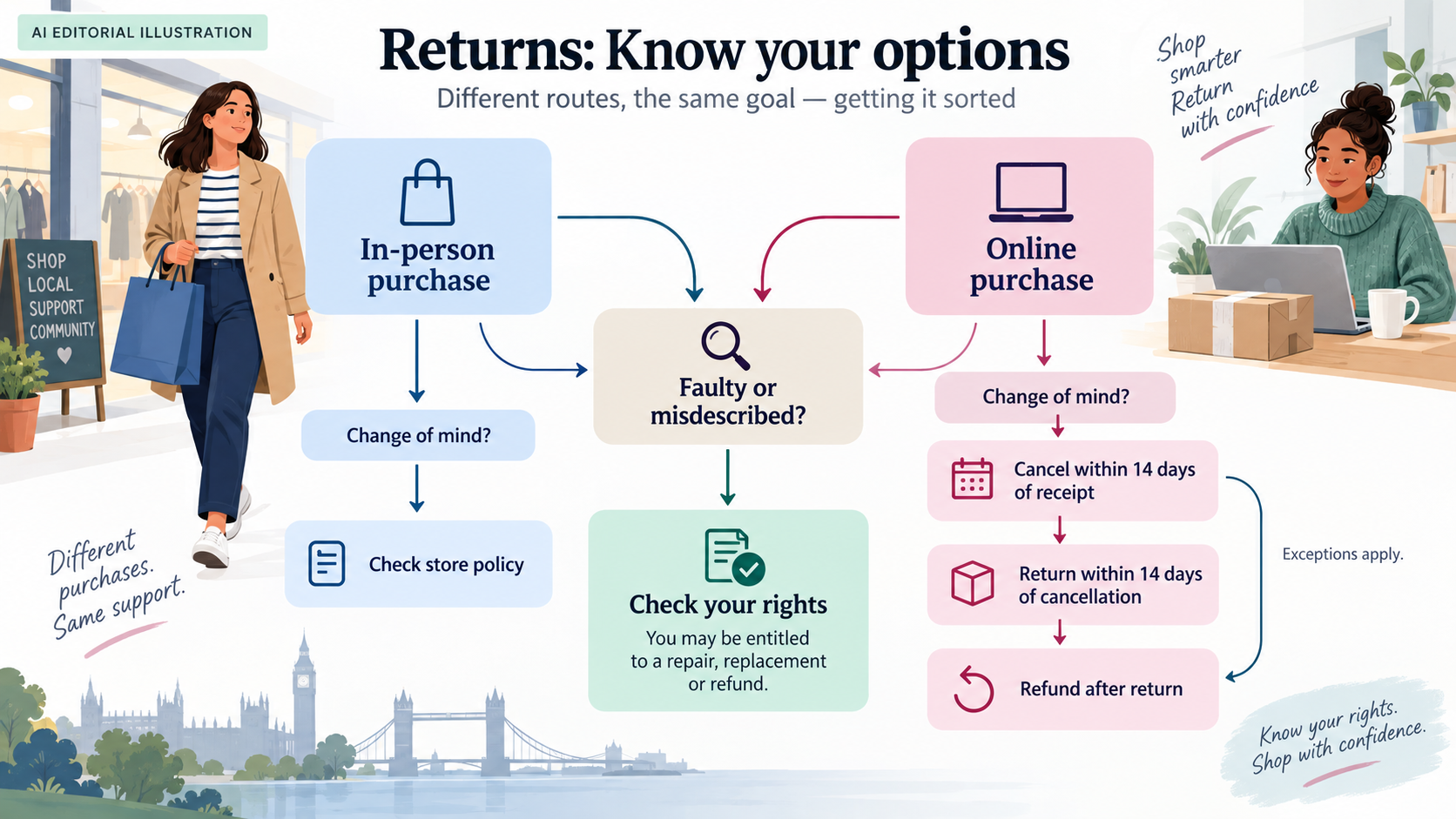
AI-generated generic editorial illustration — not a retailer product photo and does not depict the reviewed product or service. Turn the GOV.UK evidence into a pre-purchase decision aid for identifying the applicable UK return and refund route.
Before checkout, identify how the purchase will be made: in person, online, by mail or by telephone. Then read the retailer’s own terms alongside the UK legal baseline. The route matters because a change-of-mind purchase and a faulty or misdescribed item are not the same question.
GOV.UK guidance on accepting returns and giving refunds says that a full refund must be offered when an item is faulty, not as described or does not do what it is supposed to do. For an item bought in person, the same guidance says a retailer does not have to refund a customer who simply no longer wants it, such as because it is the wrong size or colour, unless it was bought without seeing it.
For online, mail and telephone orders, GOV.UK describes a cancellation route even when the item is not faulty. The sequence is:
- Tell the retailer within 14 days of receiving the item that you want to cancel.
- Return the item within a further 14 days after notifying the retailer.
- The retailer must refund within 14 days of receiving the item back.
Under the route described, a reason is not required. The guidance also says that the cost of standard delivery must be refunded. If a more expensive delivery option was selected, the refund only needs to cover the standard-delivery amount. The item may be handled as it would be in a shop, such as being tried on, but the guidance allows a deduction where the item has been used or damaged.
The page also states that sale purchases carry the same refund rights as items bought at full price. Treat that as part of your source-grounded checklist, while still checking the retailer’s procedure for starting a return, the address or portal to use, and any stated condition requirements.
Record the route before buying: purchase channel, retailer terms location, cancellation deadline if the online route applies, return instructions and the distinction between change of mind and fault. Keep the order confirmation and relevant product details with that note. This will not remove every practical question, but it prevents you from assuming that an in-person purchase has the same cancellation route as an online order.
Strengths of a Documented Clothing-Selection Process
The main strength of this sequence is comparability. Instead of allowing the most visible feature to dominate, you create checkpoints for use, measurements, care, ownership cost and returns.
The M&S size-guide directory supplies a documented starting route for category-specific sizing information. GOV.UK supplies a separate baseline for refund and cancellation questions, including the distinction between in-person and online purchases. Together, these sources support a written comparison without turning either source into proof of a particular garment’s comfort, quality or performance.
A completed record also makes your reasoning easier to revisit. You can see whether a purchase was chosen because it filled a real wardrobe gap, matched the measurements you recorded, fitted your care routine, met your cost assumptions and came with a route you understood. That is useful for comparing several garments and for learning which checks matter most to your own buying habits.
The process is deliberately modest. It improves the quality of the decision that can be made from documented information; it does not create hands-on product evidence that was never collected.
Limitations and Unknowns Without Hands-On Testing
A document-led clothing check cannot establish every quality that matters in wear. Product specifications and size information may not tell you how a fabric feels, how a garment drapes, whether its opacity is acceptable, how comfortable it is during movement, or how its shape changes after repeated use. Those questions need suitable inspection, fitting, later use or reliable additional evidence.
The measurement checkpoint also has limits. A guide can organise the information you compare, while your own preference may still be uncertain until you see the garment on your body. A supplied garment measurement can help you think about proportions, but it does not by itself settle movement, comfort or personal taste.
Care instructions document the required method; they do not tell you whether the routine will feel worthwhile in practice. Similarly, a cost-per-wear estimate depends on your assumed number of wears. If the item does not become part of your normal rotation, the estimate changes.
The returns section has a different limitation: a legal baseline does not replace the retailer’s operational instructions. Check the applicable terms and keep the purchase channel clear. Do not use the process as a product verdict, and do not describe a garment as tested, comfortable or durable unless you have evidence that supports that statement.
Frequently Asked Questions
What should I check first when buying everyday clothing?
Start with the intended use, season and wardrobe job. Write down where you expect to wear the item, how often it may be used and which existing garments it needs to work with. Then move through body and garment measurements, fabric and care, total cost, and the return route. This order keeps a product’s appearance or price from answering questions that belong to a different checkpoint.
How should I use a retailer’s size guide?
Open the official route that matches the product category. The M&S size-guides page lists routes including Women, Men and Children, with additional category choices. Record the body measurements requested by the relevant guide, then keep any supplied garment measurements in a separate field. Compare the recorded information with your own fit priorities, such as close or relaxed ease. Use the guide to document the basis of a choice, not as a guarantee of personal fit.
What should I record about fabric, care and total cost?
Copy the fabric or fibre composition and care instructions as provided, without adding conclusions about feel or performance. Record the purchase price, clearly stated charges and any ownership costs that are relevant to your situation. Estimate realistic wears and keep the assumptions visible if you use cost per wear. The point is to decide whether the item fits your routine and wardrobe, not merely whether its checkout price looks acceptable.
What is the UK online return window if I change my mind?
For the online, mail or telephone cancellation route described by GOV.UK, notify the retailer within 14 days of receiving the item, then return it within a further 14 days. The retailer must refund within 14 days of receiving it back, and a reason is not required. Standard delivery must be refunded, while a more expensive delivery option only requires the standard amount to be returned. The item may be handled as it would be in a shop, but use or damage can affect the refund. In-person change-of-mind purchases follow a different baseline, so check the purchase channel and the retailer’s own instructions.
Related reading
- Best UK high-street brands for wardrobe essentials: evidence-led top choices
- Marks & Spencer vs Uniqlo: which is better for everyday wardrobe basics?
- Marks & Spencer clothing review: strengths, limits and practical alternatives
- Uniqlo UK clothing review: who it suits and where the trade-offs sit
Editorial information: About our editorial team · Read our editorial policy · Read our affiliate disclosure.